
Category

Runway

The latest international editorial on runway, from the global desks of Avenue.

2 Stories

Model in a hand-painted amber and rose ombré couture gown on the Milan runway, photographed in golden hour light for Avenue. RunwayRunway

Glow on the Horizon: Sunset Couture from Milan

The atelier shows that defined the most romantic week of the season.

Milan's couture week ended in a wash of amber, rose, and bronze. Designers sent out gowns that seemed to absorb the last light of the day, pairing draped silhouettes with hand-painted ombré and embroidery so fine it disappeared into the fabric. The casting was as varied as the color palette — different ages, bodies, and identities sharing one golden mood. It was a reminder that luxury works best when it welcomes everyone. The week opened at Alberta Ferretti with a collection built almost entirely on chiffon in gradients that moved from apricot at the shoulder to deep rust at the hem. The show's finale — a full-length gown hand-painted over three hundred hours by a single atelier — earned a standing ovation from a front row that included clients from Riyadh, Shanghai, and São Paulo. The message was that Milanese couture, historically overshadowed by Paris, is now competing on its own terms. At Armani Privé, Giorgio Armani sent out a collection that dispensed with color almost entirely, opting instead for a study in liquid metallics — pewter, champagne, antique gold — cut into columnar gowns and softly tailored trouser suits. The tailored evening suit for women, in particular, felt like a quiet correction to a decade of gown-obsessed red-carpet dressing. Several editors called it the most confident collection of Armani's late career. The most talked-about moment came at Roberto Cavalli, where the house's new creative director opened with a trans model in a bronze mesh gown embroidered with two hundred thousand hand-applied paillettes. The applause did not stop for the length of her walk. Whatever one thinks of Cavalli's history, the decision to place that image at the front of the collection reset the conversation about who couture is for. What unified the week was a rejection of spectacle for its own sake. The clothes were slower, quieter, and more considered than the Paris shows earlier in the year. Craftsmanship was foregrounded. Runways were smaller. Notes distributed to editors listed the number of hours each look required, and the names of the artisans who had built them. It was couture behaving as it should — as the industry's laboratory, its conscience, and its highest expression of skill. The golden hour aesthetic that dominated the week will not last as a trend. Fashion never lets any single mood run for more than a season. But the values underneath it — patience, inclusion, and a return to the hand of the maker — feel more durable. Milan, this week, made the case that couture is not a museum. It is a working practice, and the light it caught was the light of a future the industry is still learning to deserve.
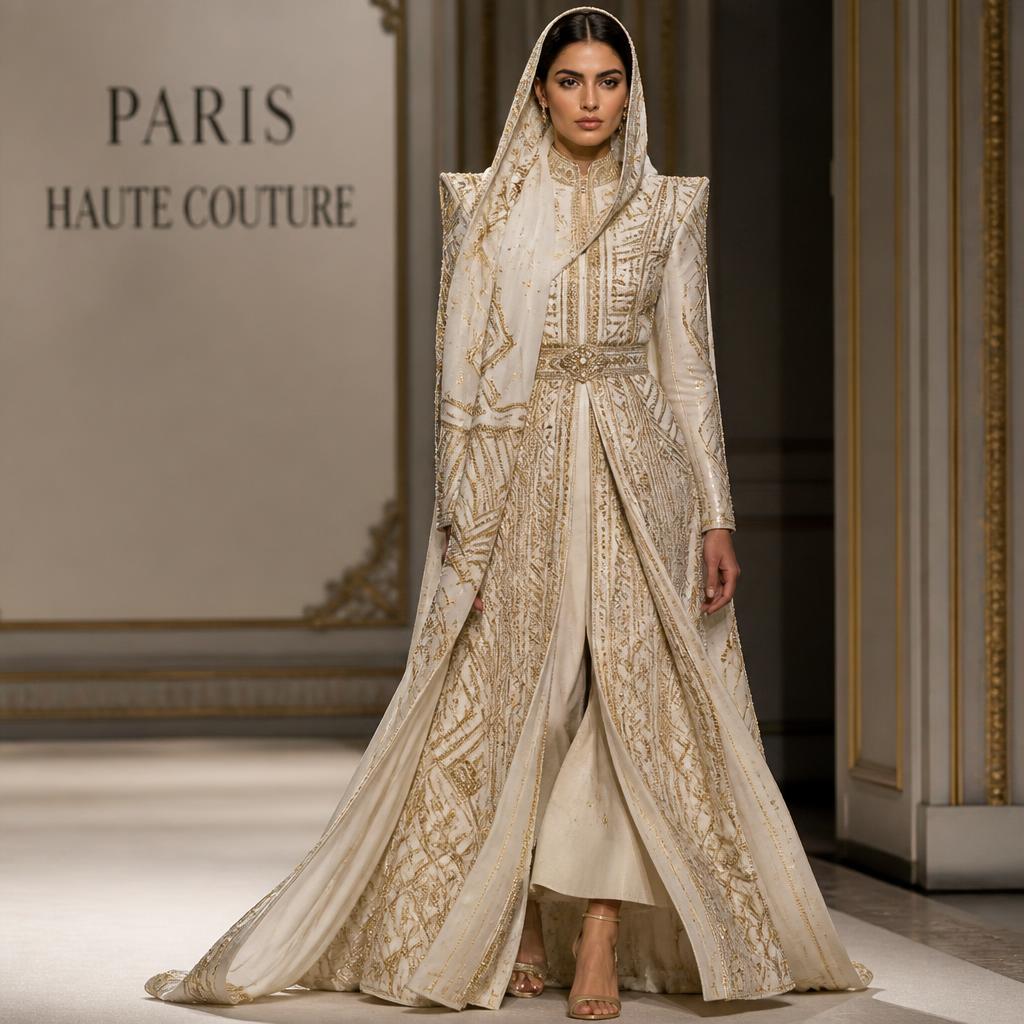
Middle Eastern woman model in an architectural cream and gold hand-embroidered couture gown walking a minimalist Paris haute couture runway for Avenue. RunwayRunway

The New Guard of Paris Couture: Six Ateliers Rewriting the Fall Calendar

The Chambre Syndicale opened its ranks this season. The result was the most consequential couture week in a decade.

For most of its history, the Paris couture calendar has been a closed system. A handful of houses, most of them older than the Fifth Republic, controlled the definition of what could be called haute couture — a legal term in France, protected by the Chambre Syndicale de la Haute Couture, that requires a house to maintain a Paris atelier of a minimum size, to present two collections a year, and to produce made-to-order garments for private clients. The threshold is deliberately high, and for decades it kept the calendar small. This season, the Chambre opened its ranks. Six new members — from Beirut, Seoul, Mexico City, Dakar, Mumbai, and Tbilisi — presented under the official couture banner for the first time. The result was the most consequential couture week in a decade, and a decisive break with the assumption that the highest form of dressmaking was a European tradition to which the rest of the world was occasionally invited. The Lebanese-born designer Nadine Kanso opened Tuesday with a collection built around silver-thread embroidery drawn from the archives of the Beit el-Din palace. The clothes were quiet, monastic, and technically astonishing. The Korean designer Seung-hyun Yoo followed with a study in hanbok proportions rebuilt in duchesse satin, worn by a cast whose ages ranged from twenty-two to seventy-eight. The Senegalese house of Mame Fagueye Bâ produced a suite of hand-loomed indigo gowns that drew the loudest applause of the week. What unified the new members was not aesthetic. It was a shared refusal to translate their traditions into a Parisian vocabulary. The clothes were confidently themselves. The Chambre, historically protective of a narrow definition of couture, appears to have finally understood that the definition survives only by expanding. The established houses, forced to share the calendar, responded with some of their strongest collections in years. Dior sent out a study in ivory pleating that felt like a direct answer to the new Asian entrants. Chanel offered its most restrained collection under the current creative director, letting the tailoring carry the show. Schiaparelli, always the loudest voice in the room, dialed the surrealism back and let the embroidery speak. The economic argument for expanding the calendar was always obvious. The private client base for couture is now global, and it wants to see itself reflected in the designers it commissions. The cultural argument is more interesting. Couture, at its best, is a laboratory for craft. Restricting that laboratory to a single geography impoverished it. Opening it may, in retrospect, be the most important governance decision the Chambre has made in half a century. What happens next is the harder question. The new members will be expected to sustain full ateliers in Paris, meet the twice-yearly presentation requirement, and build private-client books deep enough to fund their operations. Some will not survive the pace. But even if only half of them are still showing five years from now, the calendar will have permanently changed — and the definition of what counts as the highest form of dressmaking will have finally caught up with the world that wears it.